

A friend who works in our industry told me recently about a meeting in which a client asked for the lighting to be made “circadian”. She asked what they wanted it to do. There was a pause, and then somebody from the fit-out team said: tuneable white, obviously.
Tuneable-white luminaires were specified. They were installed. They were commissioned to a single scene at 4000 K, because commissioning was three days at the end of a delayed programme and nobody had written down what the scenes were supposed to be. As far as she knows, that installation has never changed colour temperature in its life.
And in the whole conversation, nobody mentioned the windows.
The project has circadian lighting in its marketing material. It has a capability nobody configured, and a façade nobody counted as part of the answer. Those are not the same thing as healthy light, and the distance between them is where this whole dimension lives.
The vocabulary arrived; the obligation did not
Something remarkable has happened in the last decade, and I do not think our profession has fully absorbed it.
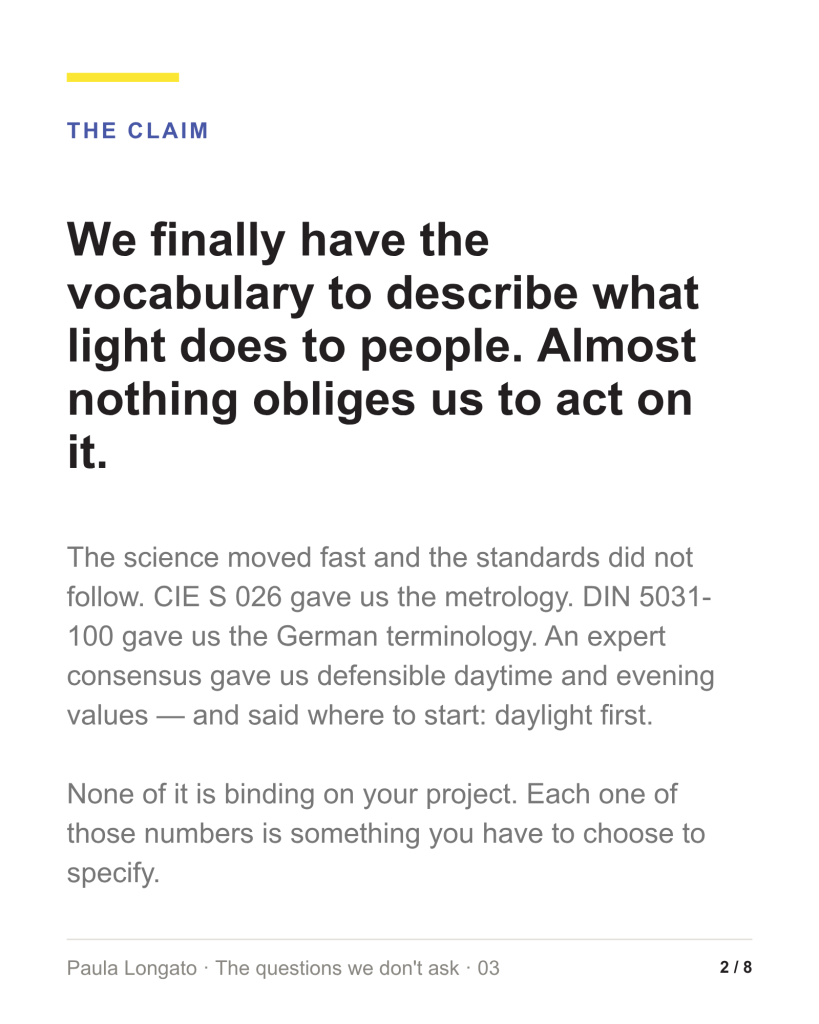
We can now describe the non-visual effects of light precisely. CIE S 026 gave us the metrology for ipRGC-influenced responses — the α-opic quantities, melanopic EDI, a defensible way to say what a light source does to the human system rather than to a lux meter. DIN 5031-100:2025-09 gives the German terminology and action spectra. These are not fringe documents. They are the settled technical vocabulary of the field.
It is worth noticing what the central unit is called. Melanopic EDI stands for equivalent daylight illuminance: it is defined against daylight. The reference for everything we now measure is the sky.
And in 2022 a group of the leading researchers published a consensus set of numbers that a designer can actually work with:
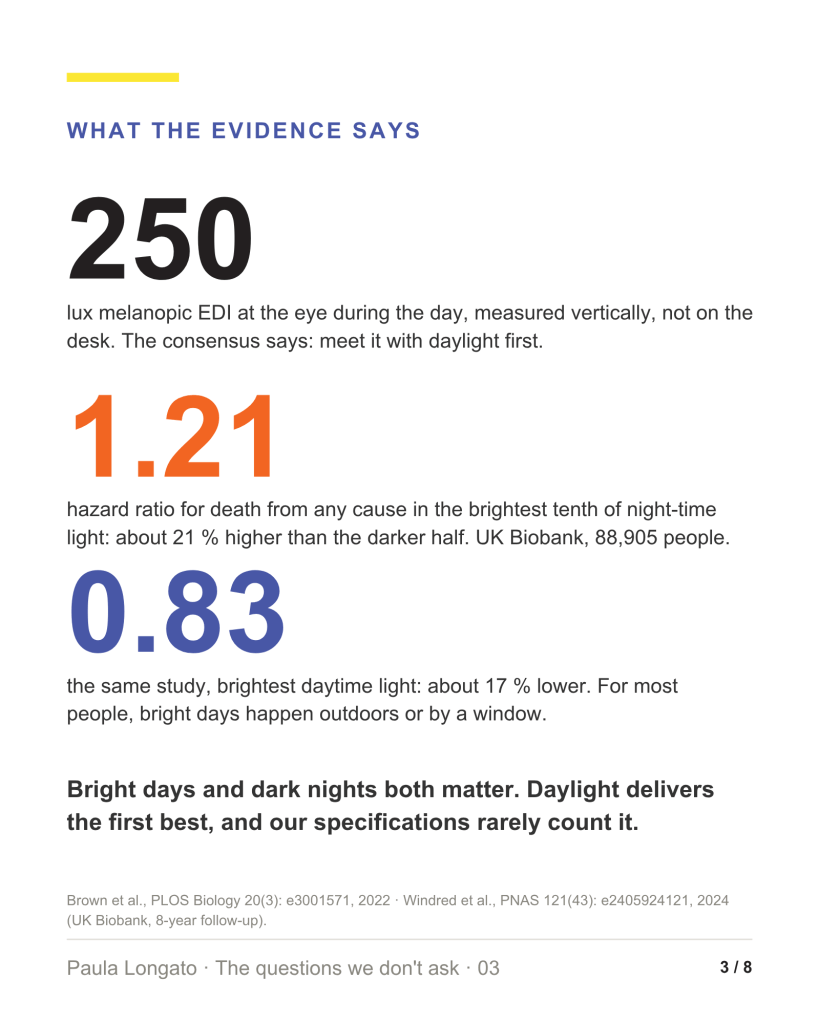
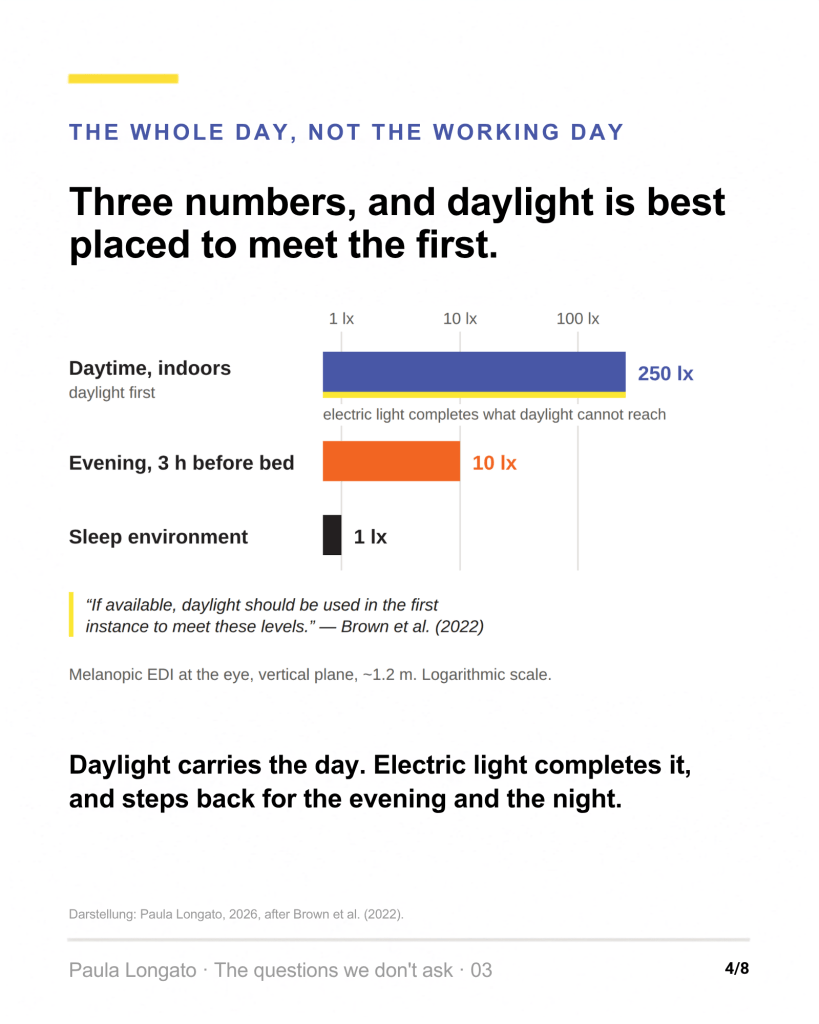
At least 250 lux melanopic EDI at the eye during the day, measured vertically at around 1.2 metres — not horizontally, not on the desk.
No more than 10 lux melanopic EDI in the three hours before bed.
No more than 1 lux in the sleep environment.
The same paper says, in one plain sentence, where the daytime light should come from: “If available, daylight should be used in the first instance to meet these levels.”
Three numbers and one sentence. Clear, defensible, published, and free.
Not one of them is binding on your project. Not one appears as a requirement in EN 12464-1. There is no compliance route, no certification that fails without them, no building control officer who will ever ask.
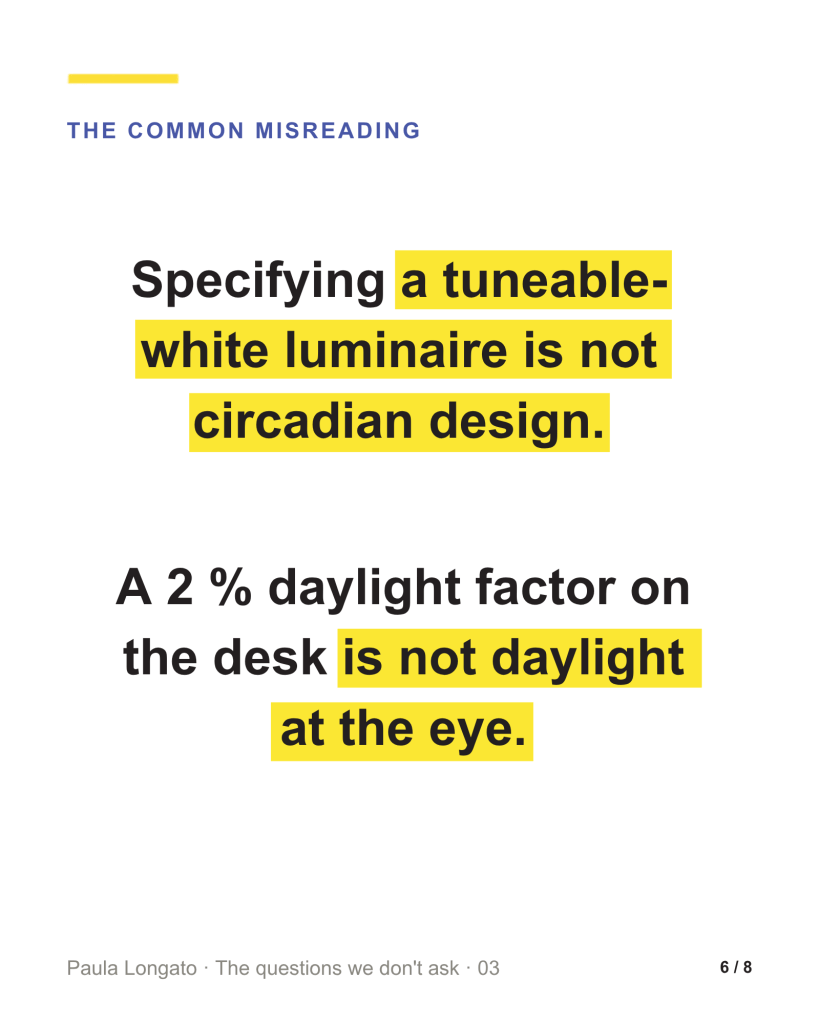
In Germany, the closest thing to an obligation points in the same direction. ASR A3.4 states that lighting with daylight is to be preferred over purely artificial lighting, and that daylight generally has a positive effect on health and wellbeing. But it expresses that preference as a daylight factor above 2 % at the workplace, or a window-to-floor ratio of at least 1:10 — a horizontal value under an overcast sky, not light at the eye across the day. It makes sure daylight enters the room. It does not ask whether it reaches the people in it.
Which means every one of the health numbers is something you have to choose to specify — and therefore something that can be removed by a person who has never heard of it, in a value engineering exercise, without anybody noticing.

The evidence got much harder to wave away
For a long time it was reasonable to be sceptical about the health claims in lighting, because much of the research was small, short and done on students in laboratories. That is no longer a fair description of the field.
The UK Biobank analysis published in 2024 followed 88,905 people who each wore a wrist light sensor for about a week — around 13 million hours of recorded personal light exposure — and then tracked their health for an average of eight years. People in the brightest tenth of night-time light exposure had a hazard ratio for all-cause mortality of 1.21 compared with the darker half of the group, and 1.33 for cardiometabolic mortality.
A hazard ratio compares how often an event — here, death from any cause — occurred in one group relative to a reference group over the same period, after adjusting for factors such as age, sex, lifestyle and socioeconomic status. A value of 1.0 means no difference. 1.21 means a rate roughly 21 % higher; 0.83 means one roughly 17 % lower. It describes an association in an observational study, not proof of cause, and the participants were middle-aged to older and almost all white British. But the direction of the result matches a large body of laboratory work.
And, in the same dataset, people with the brightest daytime exposure had a hazard ratio of 0.83 — a lower rate of death over the follow-up period than those with the dimmest days.
I want to sit on that second number, because it is the one our profession keeps skipping. Bright days appear to protect roughly as much as bright nights harm. And for most people, the brightest part of the day is not delivered by a luminaire. It happens outdoors, or near a window.
We have spent a decade arguing about circadian luminaires for offices and far less time on the other hours — the walk to work, the seat by the window, the evening, the bedroom, the corridor at 3 a.m. in a care home.
The controlled studies point the same way. In a crossover study, occupants in daylit offices with higher melanopic exposure slept 37 minutes longer and scored 42 % higher on higher-order decision-making than in the same building with lower melanopic exposure. Thirty-seven minutes of sleep is not a wellness narrative. Across a month, it adds up to more than two full nights of sleep.
Closer to home, a study at EPFL in Lausanne gave 29 young adults an afternoon of either mainly daylight or artificial light in an office-like setting. After the daylight afternoon they felt more alert at the start of the evening and performed better on demanding memory tasks; after artificial light they grew sleepier as the evening went on. And a small randomised crossover trial from Maastricht, published this year, found that people with type 2 diabetes working in daylit offices spent more of the day in the normal glucose range than under constant artificial light of around 300 lux.
There is, as yet, no German, Austrian or Swiss equivalent of the UK Biobank light study. The measurement work that could lead to one is under way: researchers at TUM in Munich lead the MeLiDos cohort, which records personal light exposure in six countries including Germany, and a Basel–Munich study found that participants in Switzerland had markedly brighter days than those in Malaysia, largely because they spent more time in daylight.
The first source is outside the window
This is where the conversation about health lighting often takes a wrong turn. We move straight from the 250 lux Melanopic EDI target to the luminaire that could deliver it, and forget that the brightest, most spectrally complete and cheapest source is already there.
Daylight is not only the reference for melanopic EDI; it is also the most effective way to deliver it. A lux of daylight at the eye counts, roughly, as a lux of melanopic EDI. Most warm and neutral white LEDs deliver noticeably less melanopic effect per lux, and how much less depends on the spectrum, which the CIE’s free α-opic toolbox will calculate. An electric-only route to 250 lux melanopic EDI therefore needs more light at the eye, more installed power and more energy than the number suggests.
Outdoors, even an overcast morning delivers light at the eye far above the daytime recommendation. A morning walk, a cycle commute, a coffee taken outside before the first meeting: these are among the most effective circadian interventions available, and none of them appears in a lighting specification. They belong in the conversation with the client about how the building will be used, and when.
Indoors, it is a question of geometry and time. Close to a façade, looking towards the window, with the blinds up, daylight alone can meet the daytime target for much of the year. A few metres further in, facing the back wall, on a December morning in Berlin, it will not. The same recommendation plays out differently in every part of the room, and differently in March than in December.
That is the balance this dimension is really about: daylight first, and electric lighting that completes the vertical illuminance where and when daylight cannot, rather than replacing it everywhere by default.
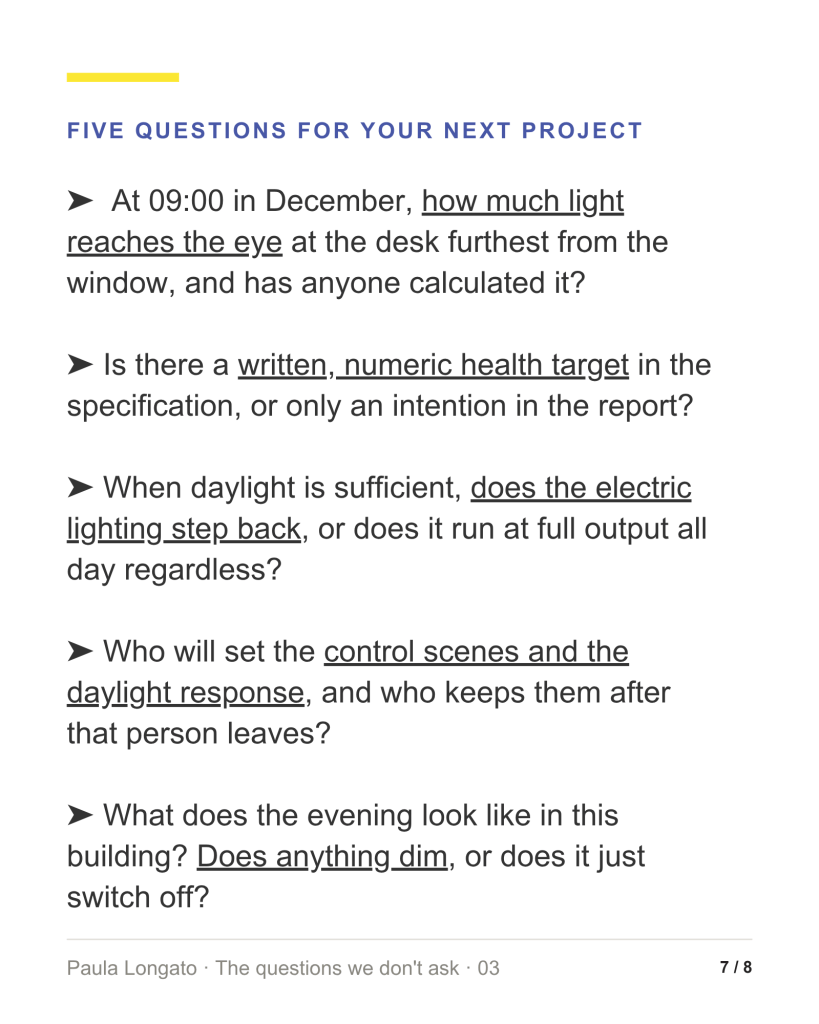
The difficult part is not the principle. It is knowing, with some confidence, how much daylight actually reaches the eye at a given position, facing a given direction, at a given hour and season, and then designing the electric lighting and its controls from that knowledge. Daylight simulation can already calculate vertical illuminance at eye height. It is rarely asked for.
The honest gap
The pattern from the first issue holds, and if anything it is starker here.
EN 12464-1:2021 did move — it added room-surface and cylindrical illuminance requirements, which is a real improvement and a quiet acknowledgement that the working plane was never the whole story. Walls above 50 lux, ceilings above 30, cylindrical illuminance at 50 rising to 150 where faces matter.
But no binding standard requires vertical illuminance at eye level to vary across the day, and none asks how much of it daylight already provides. CIE S 026 and DIN 5031-100 give you the means to describe such a scheme and to measure it. Whether to design one remains a decision that no clause will make for you, and no fee line pays for.
So the trade-off in the title is real, but it is not quite the one it first appears to be. Higher vertical illuminance in the morning supports alertness. Delivered by daylight, it costs nothing in the energy balance and even shortens the hours the electric lighting needs to run. Delivered only by electric lighting, it raises energy consumption, it shows up in the LENI calculation, and its benefit shows up nowhere at all.
The real question is not health versus energy. It is how much of the health target daylight can carry in this space, at these positions, across the year, and how precisely the electric lighting and its controls complete the rest. It is also where the three dimensions of sustainability stop pulling against each other: better for the people in the building, lower in operational energy, and cheaper to run. On many projects that question is never asked, and the answer defaults to whoever spoke last in a cost meeting.
What good actually looks like
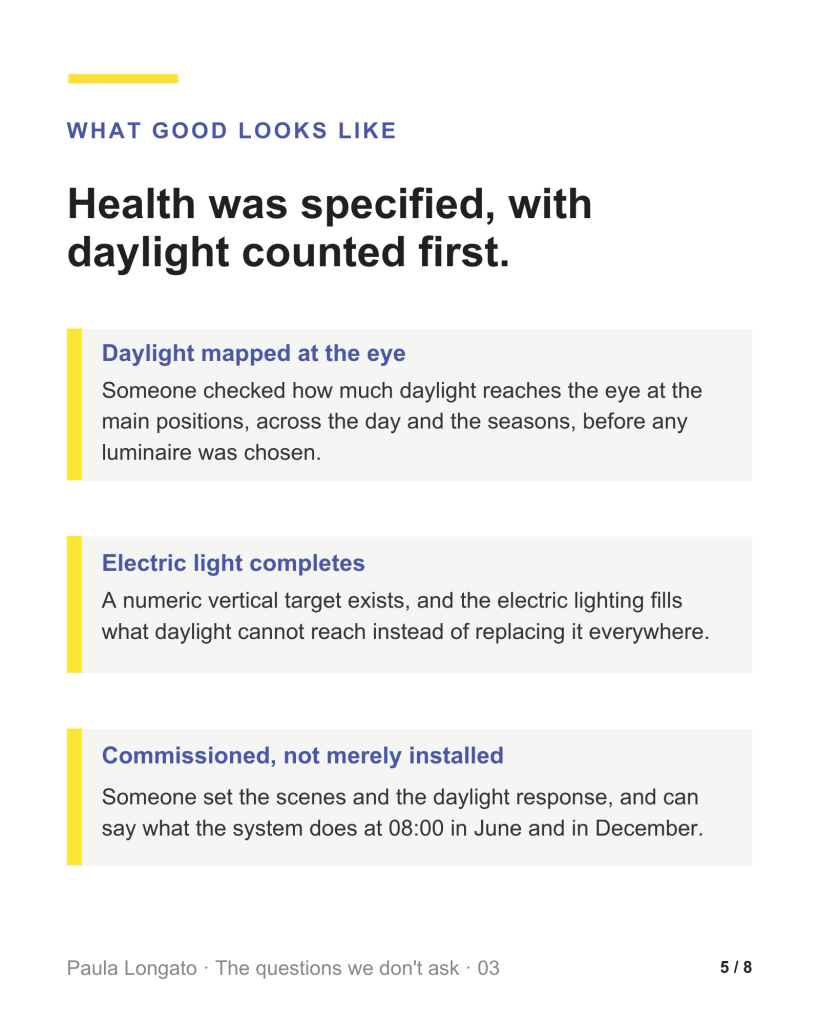
Daylight mapped at the eye first. Before any luminaire is chosen, someone has looked at how much daylight reaches the eye at the main occupied positions, across the day and the seasons, rather than inferring it from a horizontal daylight factor or working-plane value that says nothing about what reaches the retina.
Electric light designed to complete, not replace. The vertical target is written down as a number, and the electric lighting and its controls are designed to fill the gap daylight leaves (deeper in the room, on winter mornings, late in the afternoon) and to step back when daylight is enough. An intention that never became a specified requirement will not survive value engineering. If it is not in the specification, it does not exist.
Commissioned, not merely installed. Somebody set the scenes and the daylight response, wrote down what they do at 08:00 and 16:00, in summer and in winter, and left that record where the next person will find it. An installed capability nobody configured is not a design. It is an option that was never exercised.
Your turn
Daylight at the eye is the best health light a building can offer, and it costs nothing to run. Electric light completes it.
On your projects, does anyone know how much daylight actually reaches the eye, and who decides what the electric lighting makes up? And which of these are you?
- I hadn’t thought about this one.
- I already do this in projects.
- I’d want to go deeper on this.
Get in touch. I would love to hear from you.
Further reading
Brown, T.M. et al. (2022) — Recommendations for daytime, evening, and nighttime indoor light exposure to best support physiology, sleep, and wakefulness in healthy adults. PLOS Biology 20(3): e3001571. Open access. The 250 / 10 / 1 lux consensus, and “daylight in the first instance”. https://doi.org/10.1371/journal.pbio.3001571
Windred, D.P. et al. (2024) — Brighter nights and darker days predict higher mortality risk: a prospective analysis of personal light exposure in >88,000 individuals. PNAS 121(43): e2405924121. UK Biobank. https://doi.org/10.1073/pnas.2405924121
Boubekri, M. et al. (2020) — The impact of optimized daylight and views on the sleep duration and cognitive performance of office workers. IJERPH 17(9): 3219. Open access. https://doi.org/10.3390/ijerph17093219
Münch, M. et al. (2012) — Effects of prior light exposure on early evening performance, subjective sleepiness, and hormonal secretion. Behavioral Neuroscience 126(1): 196–203. EPFL Lausanne; daylight vs artificial light. https://doi.org/10.1037/a0026702
Harmsen, J.-F. et al. (2026) — Natural daylight during office hours improves glucose control and whole-body substrate metabolism. Cell Metabolism 38(1): 65–81.e10. https://doi.org/10.1016/j.cmet.2025.11.006
Biller, A.M. et al. (2026) — Physiologically-relevant light exposure and light behaviour in Switzerland and Malaysia. Journal of Exposure Science & Environmental Epidemiology 36. Basel / TUM. https://doi.org/10.1038/s41370-025-00825-8
CIE S 026/E:2018 — System for Metrology of Optical Radiation for ipRGC-Influenced Responses to Light. The metrology everything above rests on; the free α-opic toolbox is linked from the same page. https://cie.co.at/publications/cie-system-metrology-optical-radiation-iprgc-influenced-responses-light-0
DIN 5031-100:2025-09 — Strahlungsphysik im optischen Bereich und Lichttechnik, Teil 100. Current edition; the 2021 technical specification is withdrawn. https://www.dinmedia.de/en/standard/din-5031-100/392132532
ASR A3.4 (Ausgabe Mai 2023) — Beleuchtung und Sichtverbindung. Section 5.1: daylight is to be preferred; daylight factor > 2 %, or window-to-floor ratio ≥ 1:10. https://www.baua.de/DE/Angebote/Regelwerk/ASR/ASR-A3-4
DIN EN 12464-1:2021-11 — Lighting of work places, indoor. For the room-surface and cylindrical illuminance additions, and the informative annex on non-visual effects. https://www.dinmedia.de/en/standard/din-en-12464-1/334047306
DIN EN 17037:2022-05 — Daylight in buildings. Daylight provision, view out, exposure to sunlight, glare (see also Issue 01). https://www.dinmedia.de/en/standard/din-en-17037/348494031
Paula Longato · Lighting Design and Sustainability · Berlin
Leave a Reply